

This is a short guide to how I bought a keren kaspit (an Israeli money market fund) in three minutes. I did it through my bank, but you can also do it through an investment account. This is what I did and what made sense for me. Everyone should weigh up their own situation.
- US citizens: I’ve learned that these funds can raise US tax issues, so this guide isn’t intended for you. I’m not a US citizen and I’m not familiar with those tax rules. Bank deposits or directly held bonds are alternatives to ask a suitably qualified adviser about, rather than assuming an Israeli fund works the same way for you.
How I actually bought a money market fund
I logged into my bank’s website (Leumi). “שוק ההון” (Capital Markets) in the side menu took me to Leumi Trade. I searched for the fund by its security number in “חיפוש נייר ערך” (Search for a security) at the top of the page.

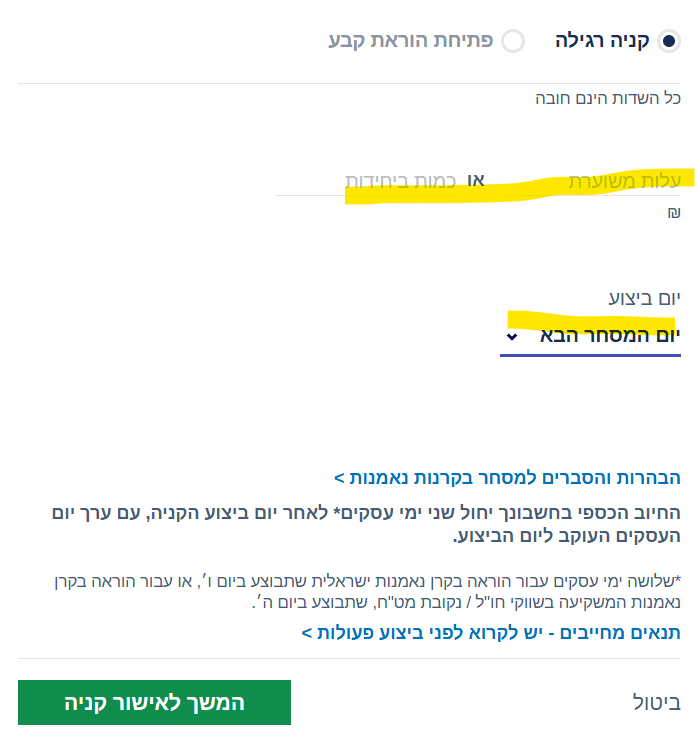
I clicked “קניה” (Buy), the big green button, and decided how much money I wanted to put in. It comes straight out of the Leumi account. I chose the next trading day for the order because it was Sunday, and there’s no trading on Sundays.
That’s it.
How I chose a money market fund
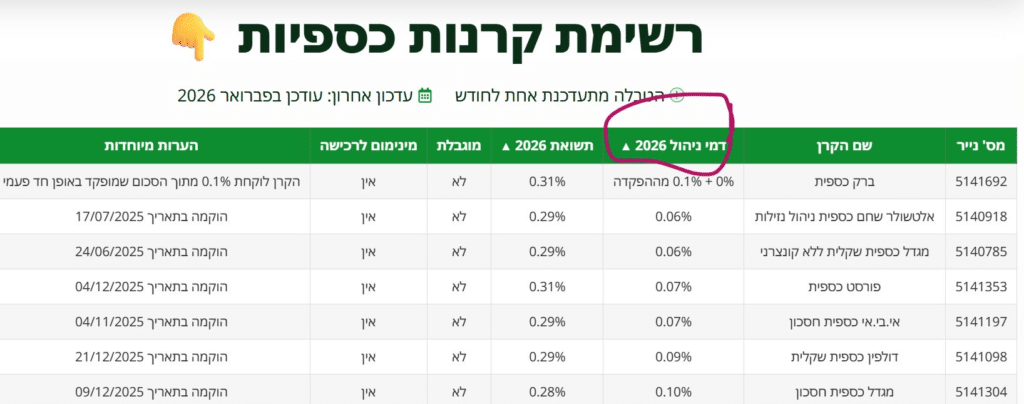
I went to the money market funds page on Tamir Mandovsky’s website and chose based on the lowest management fees.
That’s it.
The nice thing about his website is that you can filter by different criteria, including management fees. That’s the one I care about. The differences in returns are so small that any FOMO and indecision would just cost me money.
Trying to choose between options and not sure which is better? Give ChatGPT (or your favorite AI) a word problem:
“I want to put ₪X into a money market fund. Which works out cheaper for me: a fund with a 0.06% management fee, or a fund with no management fee that charges a one-off 0.1% of my contribution?”
Spoiler: for the length of time I’m putting the money away (about a year), even with my five-figure contribution, the difference is less than a cup of coffee. The differences are so small that I’m putting the money in without FOMO or getting attached to any particular fund.
Why I bought a money market fund
Because I had money set aside for a specific short-term purpose, and I didn’t want to take much risk with it.
For the business
Because this is short-term money. In another 12 months, it won’t be there anymore. For the long term, I’d buy index-tracking funds.
The longer version: I had a nice balance in my business current account after a few good months. I don’t know how the rest of the year will go, and as a self-employed person I pay myself a fixed salary. So I’m putting the money aside knowing that, in about a year, most or all of it will be gone. It’ll either go toward salaries and bills during quieter months, or toward the end of the year I’ll ask my accountant whether I can give myself a bonus in January or increase my salary.
Until then, I’m not getting carried away. Out of my current account, out of mind. I’d also rather earn a few shekels on it than have the bank make money from my balance while I get nothing. It’s mine, and I want to earn something from it.
If you’re self-employed and don’t have a separate account for your business, I suggest reading my post about opening a separate business bank account.
For the household
This particular purchase was through my business account. But my household emergency fund is in a money market fund too. It’s enough to cover four months of living expenses, and its job is to sit aside with low risk, growing just a little, roughly with inflation.
I’d also use a money market fund for money set aside for occasional large expenses, like buying a new car or renovating, when it takes a few months to save up.
We keep that in our investment account (Excellence Trade, in our case). Why there rather than at the bank? Because Idan preferred having all our savings in one place. It’s more convenient that way. I get it, and it’s not a hill I’m going to die on.
I recommend reading my post on priorities for your bank account: which money to put where, and when, to make the most of your savings and your peace of mind.
What you can take away from this
There are all kinds of short-term savings options, but money market funds are having their moment, and with good reason. Have some money sitting aside for a short time, or aren’t sure what to do with it, and want it to earn a few shekels or just be out of sight? A money market fund is one option. It’s super simple. Three minutes’ work, tops, in my experience. The differences between funds were small when I compared them, and there’s no reason for the bank to make money from your balance while you get nothing.
A few more questions
Do I need an active trading account to buy a money market fund?
Yes. You need to open your bank’s whatever-it’s-called Trade account, or an independent trading account with a provider such as Excellence Trade or IBI. At the bank it was very quick, the same day, as far as I remember. An independent account is quick too, even if it takes a little longer. A couple of days or so.
A money market fund through the bank or an investment house?
The bank’s advantage: when you buy through the bank, there are no buying or selling commissions or securities custody fees for these funds. I also don’t have to transfer money from my bank account to a trading account, send proof and wait for it to arrive. I can do it in one go. That’s what I did in my business account with money intended for the next 12 months, at most.
The investment house’s advantage is that, if you already have an account, all your savings are in one place and even further out of sight. That’s what we do with our emergency fund.
Why a money market fund rather than a bank deposit?
I want this money to be accessible. I don’t want to deal with withdrawal windows. It’s not worth the headache for a few extra shekels at the end.
What if I want to put some dollars away for a short time?
I’ve never tried it myself, but I’ve learned that dollar-denominated money market funds exist: funds you can buy directly in dollars.