
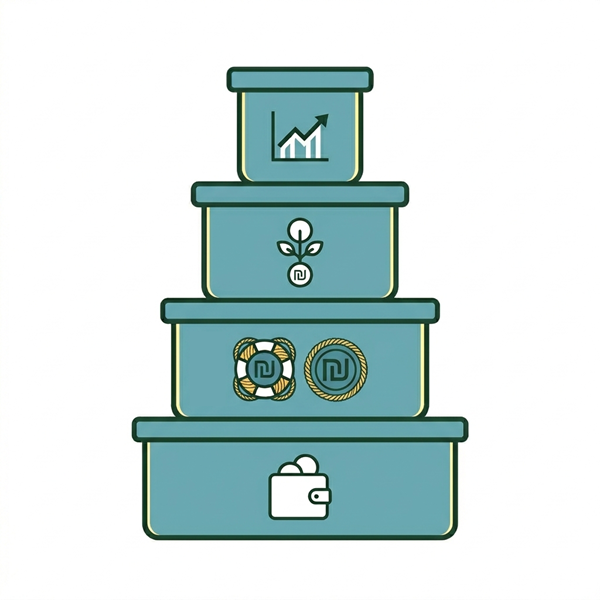
What you can measure (and see with your own eyes), you can manage. So here’s my recipe for keeping the different parts of your bank balance separate.
The goal: an organized, predictable cash flow. Instead of mixing all your money together, know exactly what is for everyday household expenses (housing, credit-card payments and so on), what is set aside for something specific (a car, a holiday, an event, renovations, paying down your mortgage), and what is long-term savings.
A note for US citizens: there are US tax issues to consider that I, as someone who isn’t a US citizen, am not familiar with.
When I talk about all this money, I mean what’s left in your account on the 11th of the month. In other words, after everything that needs to come in has come in, and everything that needs to go out has gone out: your salary has arrived, your monthly credit-card payment has gone out, your housing payment has gone out, and so on. If yours are spread over more dates, align whatever dates you can. If your salary arrives by the 10th, is there a reason your credit-card payment goes out on the 15th? You can sort that out with a quick visit to your card company’s app or website. If you can’t change the dates, set money aside for those payments too.
So here’s my recipe for separating things out and setting financial priorities:
Your personal bank account
0. If you have debt, start by paying it back
Because of the high interest and the mental burden, pay back your debts and get back on your feet financially first. Save afterward. (I have a guide to paying off debt.)
Of course I mean debt to the bank, family members or an institution. The kind with high interest and a heavy weight on your mind. A business startup loan or mortgage, with regular payments that are part of your cash flow and an interest rate that isn’t high, is a different story.
1. Leave a few thousand shekels in your bank account
Leave just a few thousand in your bank account, your “new zero,” as a tiny emergency fund. Five thousand, three thousand, ten thousand. Whatever works for you. I wanted ₪3,000, Idan wanted more, and we met in the middle.
The goal: if you’ve had a particularly expensive month (for example, we hate installments and prefer paying even arnona, the local municipal tax, and car insurance in one payment when possible), and then another expense comes along, you won’t go into overdraft.
2. Save for an emergency fund
Put your actual emergency fund, covering 3–6 months of living expenses, in a conservative investment (ours is in an Israeli money market fund, or keren kaspit). I wanted it in the trading account at First International Bank (where our joint account is). Idan preferred our investment account at Excellence Trade, to keep everything in one place. Either way is fine. What matters is that it’s convenient for you and that you can access the money quickly.
Once you’ve reached that amount, you can stop saving toward it.
For money I’d need soon, I’ve written about buying a money market fund through my bank.
3. Every shekel beyond that goes to saving or investing
- We start by contributing to a keren hishtalmut (an Israeli savings and investment fund) as self-employed people, because of the Israeli tax benefits: tax deductions on eligible contributions and a capital gains tax exemption, within the relevant limits. The exemption is subject to withdrawal conditions, usually six years from the first contribution. It takes us a few months to finish our contributions. Every year I promise myself I’ll set up a standing order next year, but it hasn’t happened yet.
- Once we’ve finished those contributions, what’s left for the rest of the year goes into our investment portfolio.
- If you have a standing order for your keren hishtalmut: you’re more organized than I am. Once I finally set mine up (next year. I promise.), I’ll just put money straight into the investment portfolio.
- Parents: a standing order for your children’s savings should be part of your regular cash flow, rather than “every shekel beyond that.”
- We’re not planning an event, and, touch wood, we can currently cover large expenses out of our regular cash flow. But if you have a bat or bar mitzvah coming up, are planning a big family holiday, or know you have large expenses ahead, put money into a separate daily shekel money market fund (these funds are broadly similar, though management fees differ) for that purpose. It doesn’t belong in your emergency fund.
I’ve also written about why I like keren hishtalmut funds.
If you’re self-employed
What works for an organized, predictable cash flow in your household account works for your business account too. So:
0. Open a separate business account
If you don’t have a separate business account, open one urgently. It clears your head and gives you peace of mind. I’ve written a whole post on why you should open a separate account for your business, and it’s one of my best tips for people who are newly self-employed.
1. Transfer yourself the same amount in pay every month
How much? Ask your accountant. They’ll know how to work it out. This lets you manage a sensible cash flow around your income and expenses.
2. A surplus in your business account? Into conservative savings it goes
For exactly the same reason as with your personal account: if your current-account balance doesn’t earn interest, that money isn’t working for you. The bank earns from it; you don’t. Conservative, easily accessible short-term savings let it earn you a few shekels while it’s waiting to be used, whether that is for paying income tax or your next pay transfer.
Putting it all together
When your money is organized, you know exactly how much you have to spend, how much is set aside for a rainy day or a specific need, and how much is working for you over the long term. Cash flow becomes predictable, decisions become easier, you feel more certain and less stressed.
It isn’t complicated. First you pay off debts, then build a small buffer in your current account, then an emergency fund, and then everything else goes into savings and investments. If you’re self-employed, you do the same thing twice: once for the household and once for the business. Once it’s organized, you don’t have to keep thinking about it. Just do it.
When do you put this money aside?
On the 11th of the month, after your living expenses have gone out and your salary has come in, when you know how much money you have available in your account.
How much money is “a few months of living expenses” in an emergency fund?
The usual number is 3 to 6 months. We went with 4. Whatever lets you sleep comfortably at night is the right amount.
What is the difference between an emergency fund and money set aside for a holiday, event or renovation?
An emergency fund is for emergencies: not working, illness or an urgent repair. It doesn’t get used up because you bought tickets for a trip. This money has to be kept separate.
How much money should you set aside?
These are the rules of thumb:
Your “new zero” in your current account: anything between ₪3,000 and ₪8,000 seems great to me. It depends on how high your expenses are, how much they fluctuate, and how anxious you feel.
Emergency fund: 3–6 months of living expenses.
Money set aside for a specific purpose: enough to cover the planned expense.
Investment portfolio: the more, the better.