

How do you open an investment account? If you want to invest and have no idea where to start, here’s how I opened mine, put together a portfolio and chose the indexes I wanted to invest in.
A note for US citizens: there are US tax issues to consider that I, as someone who isn’t a US citizen, am not familiar with.
This is how I opened my investment account, and how you can open one too.
This article is not a professional guide, and it is certainly not investment advice. That’s what professionals are for. I’m explaining what I did to go from having no investment account to having one. Strictly speaking, what I bought wasn’t exactly stocks; it was funds. I’ll explain the difference later. For now, you buy them in the same way, so I’ll use “funds” and “stocks” loosely until we get there.
One important tip before you start: leave the FOMO and perfectionism behind. They’ll only slow you down.
I realized I wanted to invest in the stock market
I was curious about investing for years before I actually started. I didn’t know how to go from owning no stocks to owning some. I read, asked beginner questions, joined Facebook groups about money and the stock market, and still couldn’t see where to begin.
I wanted to start investing in the stock market for a few reasons:
- I want money.
- Work alone doesn’t make you wealthy.
- The next step is to take the money I earn from work and buy things that will help me make money.
- I didn’t have enough money to invest in something big, like property or buying a company.
- I didn’t know enough to invest in something big, like property or buying a company.
All that time I kept telling myself: damn it, I’m in my late twenties. I’m not getting younger, compound interest isn’t going to build itself, and people less clever than me manage to do this. I can too.
I figured out how to invest in the stock market, in theory
Then I found Hasolidit, the queen of the Israeli investing blogosphere, who has helped many Israelis keep more money in their pockets. In January 2021 she published a detailed step-by-step guide to buying stocks, ETFs and mutual funds.
The post was thorough, as her posts tend to be. The crucial thing I learned was that I had two ways to invest:
- Through a bank.
- By opening an account with an investment house.
After I published this post, people told me that you can sometimes negotiate, or simply ask nicely, and be allowed to open an account with less. I didn’t know that at the time.
The difference between trading through a bank and an investment house
Here’s how I summed up the differences that mattered to me:
| Through a bank | Through an investment house | |
|---|---|---|
| Minimum amount to open an account | No minimum | Tens of thousands of shekels |
| Fees | Higher | Lower |
| Moving money from your current account to buy | No transfer needed; the trading account is linked to your current account | Transfer the money, report the deposit, then trade |
| Phone support | Yes | Yes |
I’m a Bank Leumi customer. My parents opened a Leumi Trade account for me years ago, with a little money in a fund they bought that hadn’t done much. I didn’t have ₪20,000 sitting in my current account to open an account elsewhere. If I wanted to trade through Leumi, I could call the bank and do it.
I bought my first stock
On an impulsive day in April, I put ₪2,500 into shares of an Israeli company. Some people comfort-shop; others demolish something sweet and doughy. I soothed myself by shaving ₪2,500 off my balance for a real-estate company I’d been watching for a few days and thought might do well.
Why? Partly because I was in a bad mood and wanted to do something impulsive, and partly because it was time to stop being afraid and start buying, even if only to learn what it felt like and how it worked. Instead of standing beside the pool and studying it from every angle, I jumped in.
The trouble with smart people and nerds like us is that we think too much and act too slowly. I could have deliberated forever. I chose to do it and learn as I went.
I won’t get into the technical steps, with terms like “points” and “limit.” There’s plenty on YouTube, in Hasolidit’s post I linked above, and through the phone support of whichever provider you use.
I have an old Leumi Trade account. The fees are high (₪26 per buy or sell order). I didn’t yet have a spare ₪20,000 to open an account elsewhere, and learning to do it and see how it works mattered more than waiting for the stars to align.
— Lior Shapira, April 28, 2021
I’m a big believer in “just do it,” especially with small amounts while you’re learning. I talk more about that approach, and getting past the fear, here.
By the way, I sold that stock three years later at a loss of about half my investment. I’m still so glad I bought it. Without that purchase, I wouldn’t have started investing.
In your case, you could simply watch how a stock performs and decide to sell if it hasn’t gone up after a set period, say six months. I mostly didn’t sell because I was lazy.
We decided to open an account with an investment house
That’s the story of my first stock. The point of telling it is to show how I went from no investment account to having one. One stock still isn’t a portfolio.
As the table shows, the bank had no opening minimum but charged higher transaction fees. Even though we planned to invest for the long term and make few trades, we’d rather keep our money with us than with the bank, thanks.
When I opened my account, ₪20,000 was the minimum for an investment account. Idan, my partner, and I saved that amount over several months. Having it in mind gave us a target to work toward.
In the years since, investment houses have realized they really, really want your money with them. Today, the numbers are much lower:
- Excellence Trade: ₪10,000 minimum to open an account (down from ₪20,000).
- Psagot Trade: ₪10,000 minimum (down from ₪20,000).
- Meitav Trade: as of October 20, 2026, the website advertises accounts from ₪5,000 and lists ₪10,000 for its general plan on the same page. Check which plan and terms apply to you before signing up. The previous minimum was ₪20,000.
- IBI Trade: the offer checked on October 20, 2026 requires at least ₪15,000 in cash and/or financial assets, subject to the company’s terms (previously ₪50,000).
We chose the mix for our portfolio
On the stock market you can buy individual stocks, ETFs and mutual funds. Now it’s time to explain the difference between a stock and a fund. First, a caveat: I don’t want to get into the differences between ETFs and mutual funds. Hasolidit and Google can point you to professional explanations. In brief, a stock represents one company. An index is a group of stocks. An index-tracking fund aims to track the returns of that group. We wanted funds that track indexes, rather than individual stocks.
What is a stock index?
An index is a group of stocks with something in common, put together by exchanges and other companies around the world. They might share a geographic market (Israel, the US or the world), company size (the S&P 500, TA-35 or TA-125), or a sector (technology, construction or companies that trade in gold).
Why did we invest in indexes?
We chose indexes for two reasons:
- We wanted to be lazy investors. We didn’t want to read company reports and follow every rise, fall, merger and acquisition. If a stock falls sharply or a company disappears, we’d rather have someone else deal with the index. We wanted to buy the same sort of product each time without thinking too hard. Thanks, bye.
- We believed indexes performed better than individual stocks over time. That made it easier to be lazy. You still need to understand and read information about indexes, but there is plenty to read about their long-term performance compared with individual stocks. That’s a broad statement, of course, and “over time” is the key phrase. There’s an example here.
Which indexes should we invest in?
To choose something, you first need to know it exists. When I started planning our portfolio, I knew four indexes: the S&P 500 everyone talks about, which Idan’s and my keren hishtalmut funds were invested in; Nasdaq; TA-125; and a real-estate index. “The ones I know” isn’t a sound way to build a portfolio.
I’ve written more about keren hishtalmut funds.
I looked at TheMarker Trade, Bizportal and even Yahoo Finance to discover more, but mostly got confused. So I turned to the crowd and asked on Twitter which indexes might be interesting to look at.
Finance Twitter: Next week, God willing, Idan and I are opening an investment account. We’re planning a passive investment for around ten years, hopefully toward buying a home. Our keren hishtalmut funds are in the S&P 500. Which other ETFs and index-tracking funds should we look at? (Obviously, you’re not making a recommendation!)
— Lior Shapira, August 11, 2021
Putting our index mix together
After people sent us a good number of suggestions, we chose what to invest in. We wanted exposure to different places and currencies, rather than everything in one market or one currency. The aim was to avoid putting all our eggs in one basket and reduce swings that could put the money at risk.
We settled on five indexes: Israeli, American, global, emerging markets and European.
I won’t name the five specific indexes, mainly so no one can say we’re recommending them. Sorry, but legal self-protection is no joke. As we were both already invested in the S&P 500 through our keren hishtalmut funds, we didn’t want to double up. For the American market we picked an index of smaller companies.
We showed the plan to my sister’s partner, who works in the capital market, and to Idan’s mother, an experienced amateur investor. She suggested replacing one index with a technology-company index. It sounded interesting, so we replaced the weakest of the five. Four geographic areas and one sector felt like a reasonable spread to us.
Choosing the specific funds
We had our mix. Now how would we buy it?
Different investment houses can offer funds that track the same index. The Israeli site Funder (thanks again to my mother-in-law) compares them. This example fund page shows an Israeli provider under “fund manager” (מנהל הקרן), to give you a starting example.
You can look at investor ratings, returns and management fees when funds seem alike. Once you choose one, click its name and copy its security number. That number identifies the particular tradable security, so you can buy the fund you intended even when several providers offer funds tracking the same index.
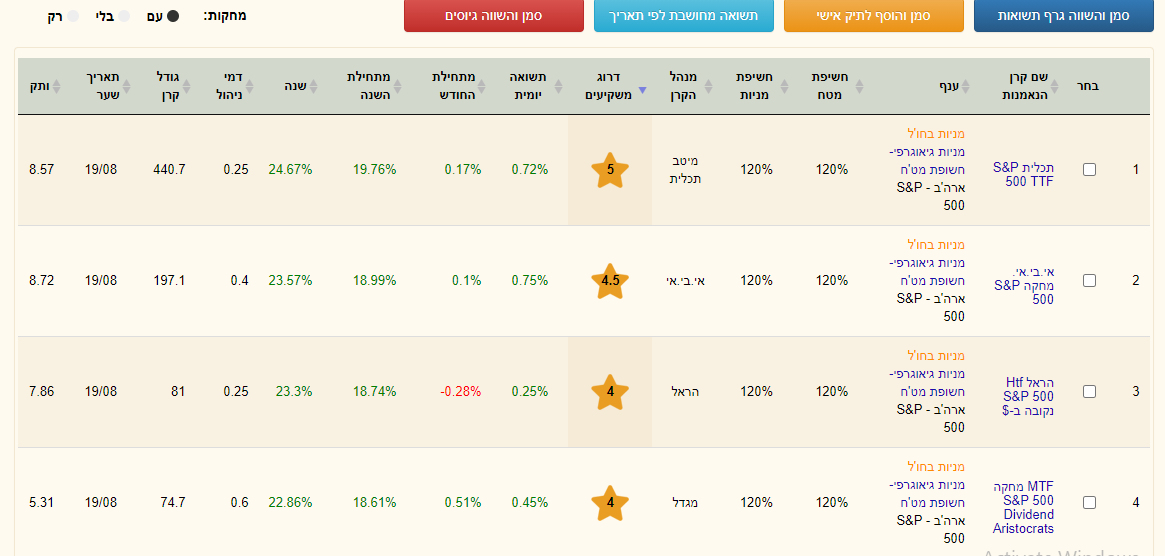
We made a spreadsheet with each fund’s name, its Funder page, its market and its security number. That let us check the details and copy the right number when we bought.
We chose an investment house
We saved the ₪20,000 that was then the minimum for opening an account at an investment house. That gave us the choice of Psagot or Excellence; the others asked for higher initial amounts.
Our call with Excellence was short and practical. Psagot didn’t answer the phone or call us back, and the fee schedule I found online looked similar but slightly more expensive. So, Excellence it was. We opened the account online quickly.
June 2022 update, checked again in October 2026: If you’d also like to open an Excellence account, you can use my link. As I write this, people signing up through my link receive a ₪100 gift, and it helps me too.
We opened the account
Opening involved a short call with Excellence and then filling things in on the computer. We got the account details by email a few days later.
We deposited an initial ₪20,000. Reporting the deposit confused us: the site seemed to let us report deposits to a keren hishtalmut or a pension, but not to an investment account. Idan sorted it out with customer service on WhatsApp by sending a photo of the transfer confirmation.
The screenshot in the source shows their old interface. Today’s interface looks a little different.

We bought the funds. We had a portfolio!
Seven months after Hasolidit’s post, four months after I bought my first stock and about a week after opening our account, Idan and I sat down one morning to buy our funds. Five indexes, 20% in each. I may have played “Namer HaKesef” (Money Tiger) and danced a little from excitement.
Further reading
- My YouTube playlist about investing and making money.
- Six stock indexes beginners should know.
- Nine leading stock indexes around the world.
Are you sure you chose the best possible mix?
The stock market is full of FOMO. You can always worry that something better is around the corner, or sell and switch. But if you’ve learned enough to explain why you made your choices, that’s good enough. Having a portfolio matters more than having a perfect one.
Why did you decide to invest in the stock market?
Because I wanted money, work alone wasn’t enough, and I didn’t have enough money or knowledge to invest in property or buy a company.